

A car hauler inspection is not something that happens once a year and then gets checked off the list. A transporter needs to be safe before it leaves, its cargo needs to remain secure on the road and anything that changes during the trip needs attention before it becomes a bigger problem.
There is another inspection that matters just as much to the person shipping the car. Before loading, the driver and customer document the vehicle’s condition. They repeat that process at delivery. Those two walk-arounds provide a before-and-after record if there is a question about damage.
For interstate carriers, inspection and maintenance are also federal compliance issues. The Federal Motor Carrier Safety Administration requires commercial vehicles to be properly inspected, maintained and kept in safe operating condition.
What Does FMCSA Require from a Car Hauler?
Federal regulations require motor carriers to systematically inspect, repair and maintain the commercial vehicles they control. That includes both the truck and trailer.
Commercial vehicles must also receive a periodic inspection at least once every 12 months. On a tractor-trailer combination, each unit is subject to the requirement.
Passing an annual inspection does not give a carrier a free pass for the next 12 months. Tires wear. Lights fail. Air lines leak. A suspension component that was fine during the annual inspection can develop a problem thousands of miles later. Federal rules prohibit operating a commercial vehicle when its condition is likely to cause an accident or breakdown.
For consumers, FMCSA registration also provides a useful way to check the company moving their vehicle. A carrier’s USDOT number can be used to look up basic registration and safety information before booking a shipment.
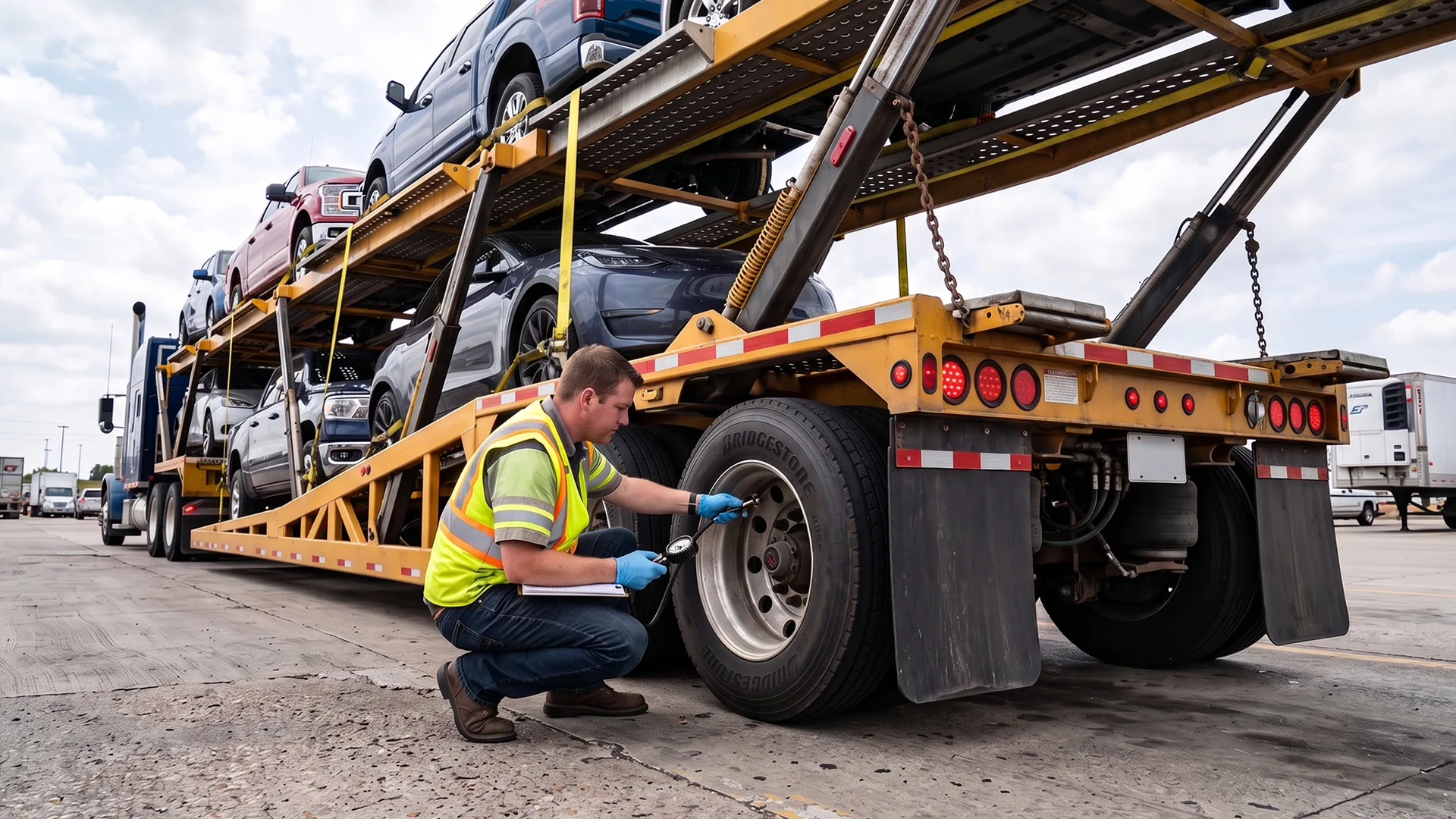
What Should Be Checked Before a Car Hauler Leaves?
A useful truck inspection checklist concentrates first on the things that can make a loaded transporter unsafe.
Start with the tires and wheels. Tire pressure, tread condition and visible cuts, bulges or other damage deserve attention before a long trip. Wheels, rims and fasteners should also show no signs of damage or loosening.
Brakes are just as important. A loaded car carrier has considerably more mass to bring to a stop than an empty tractor. Brake components, hoses and connections need to be in working condition with no defect that compromises safe operation.
Drivers also need to look at the equipment that is easier to overlook during a rushed pickup. That includes headlights, turn signals, brake lights, marker lights and trailer electrical connections. Steering and suspension components, the coupling system, trailer structure and loading ramps are part of the picture, too.
Car Hauler Inspection Checklist
Inspection Area |
What to Check |
When to Check |
Why It Matters |
|---|---|---|---|
Tires and Wheels |
Inflation, tread, visible damage, wheels and fasteners |
Before departure and during stops |
A tire or wheel problem can cause a breakdown or loss of control |
Brakes |
Brake operation, hoses, connections, leaks and trailer brake components |
Before departure and whenever braking performance changes |
A loaded transporter needs its full braking capability |
Lights and Electrical |
Headlights, brake lights, turn signals, marker lights and trailer connections |
Before departure and during the trip |
Lighting lets other motorists see the hauler and understand what the driver is doing |
Frame and Trailer |
Frame, suspension, coupling equipment, ramps and structural damage |
Before loading and during routine maintenance |
Damage can affect the stability and safe operation of the transporter |
Tie-Down Equipment |
Straps, chains, hooks, attachment points and visible wear |
During loading and again during the trip |
Proper securement keeps the vehicles from moving on the trailer |
Vehicle Condition Documentation |
Scratches, dents, chips, glass, wheels and other existing damage |
At pickup and delivery |
Creates a record that can be compared if damage is reported later |
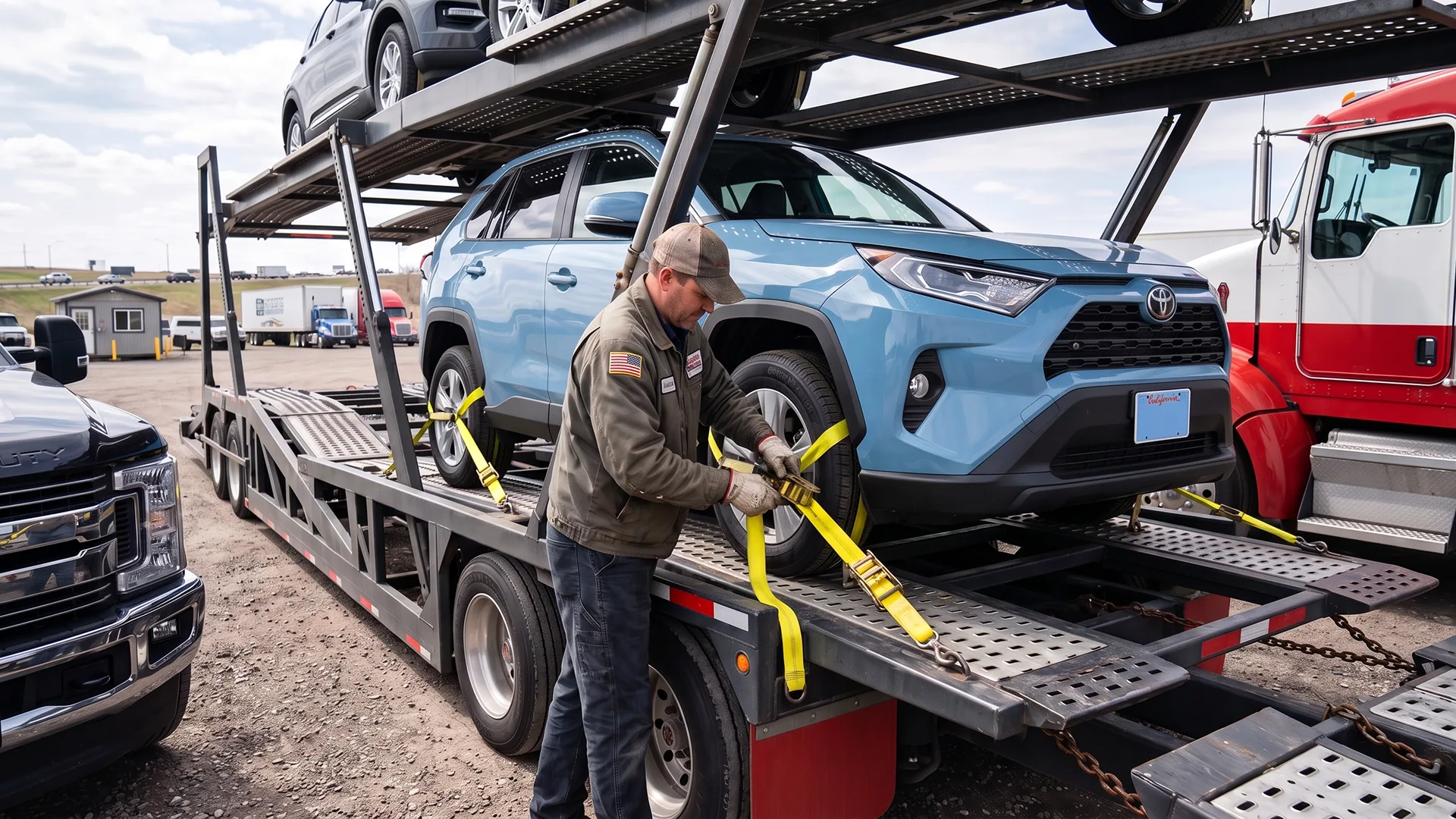
Tie-Down Equipment Needs Its Own Inspection
A truck can be mechanically healthy and still be unsafe if its load is not secured correctly.
Car hauler equipment works hard. Straps can become worn or cut, hooks can be damaged and attachment points can loosen. Drivers want to find those problems while the truck is sitting still rather than after a vehicle has shifted on the trailer at highway speed. That’s why a commercial vehicle inspection checklist is so helpful.
FMCSA has specific cargo-securement rules for automobiles, light trucks and vans weighing 10,000 pounds or less. Those vehicles must be restrained at the front and rear against movement. Vehicles weighing more than 10,000 pounds fall under the requirements for heavy vehicles, equipment and machinery.
The details matter because securement is more than pulling a strap tight before departure. The equipment has to be appropriate for the load, attached correctly and in serviceable condition.
What Gets Checked During Transport?
The inspection does not end when the truck pulls away from the pickup location.
Cars settle slightly on their suspensions. A strap may lose some tension. A tire can begin losing air after picking up road debris. An electrical connection can work loose and take out a trailer light that was operating normally an hour earlier.
That is why stops during a trip are an opportunity for more than fuel and coffee. A quick walk around the transporter can catch something that has changed since departure. The driver can look at the tires, lights, load and securement equipment and deal with a problem while the truck is safely parked.
This is where the idea of an FMCSA vehicle inspection makes more sense as an operating practice than simply as paperwork. The goal is to prevent unsafe equipment from continuing down the highway.
The Customer’s Vehicle Gets an Inspection, Too
The inspection performed on the car at pickup serves a different purpose. It establishes what the vehicle looked like before it was placed on the transporter.
Ideally, the car should be reasonably clean. Dirt and road grime can conceal a small dent, paint chip or scratch that becomes obvious later. The customer and driver should walk around the vehicle in good light and note existing exterior damage.
Take your own photographs as well. Get clear images of all four sides, the wheels and the glass, along with close-ups of existing damage. There is little downside to having a few extra photographs available if you need them later.
The condition report is normally documented with the bill of lading, which records important information when the vehicle changes hands. Read the condition section before signing rather than assuming everything has already been noted accurately.
Inspect the Vehicle Again at Delivery
When the transporter arrives, compare the vehicle with the condition recorded at pickup before signing the final paperwork.
Walk around the entire car. Look at the body panels, bumpers, wheels and glass. If delivery takes place after dark, use a flashlight rather than postponing the inspection until the next morning. The driver may have another stop to make, but that is not a reason to rush through your part of the delivery.
If you spot damage that was not present at pickup, photograph it and make sure it is noted on the delivery paperwork before you sign.
The paperwork itself does not guarantee that an insurance claim will be approved. What it does is establish what was observed while the vehicle was still being delivered, which can become important evidence if a claim is necessary.
This is also why it is worth understanding auto transport insurance before the carrier picks up the car. Trying to determine what coverage applies is much easier before there is a problem than afterward.
Make the Vehicle Easy to Inspect at Pickup
A little preparation helps both the inspection and the loading process.
Wash the vehicle if practical and remove personal belongings. Have the keys available and make sure the car has enough fuel to be driven on and off the transporter without carrying unnecessary extra weight.
Tell the transport company about anything unusual before pickup. A non-running car may require a winch. Very low ground clearance may change the way the driver approaches the ramps. Oversized tires, suspension modifications or other changes can also affect loading.
Someone responsible should be present when the driver arrives. Give that person enough time to inspect the car and review the paperwork rather than treating pickup as a handoff that needs to be completed in two minutes.
For moves involving unusual ownership circumstances, recently purchased vehicles or international destinations, it is also smart to check what documents are required to ship a car before pickup day. Discovering that something is missing after the truck arrives can turn a simple shipment into an avoidable delay.
Why Inspection Records Matter to Carriers
For a professional carrier, good inspection practices leave a paper trail as well as a safer truck.
FMCSA requires carriers to keep maintenance records for vehicles they control for 30 consecutive days or more. Those records identify the vehicle and document the inspection, repair and maintenance work performed.
The annual periodic inspection creates another record. A copy of that inspection report must generally be retained for 14 months after the report date.
Roadside inspections create records of their own. When violations are found, the carrier may need to document that the problem was corrected. That gives regulators a record showing not simply that a defect was discovered but how the carrier responded to it.
None of that paperwork replaces the driver’s judgment on the road. A current inspection decal will not make a damaged tire safe or tighten a loose strap. Documentation and hands-on inspection serve different purposes, and a well-run transport operation needs both.
FAQs
What defects require a car hauler to be taken out of service immediately?
Not every defect automatically puts a commercial vehicle out of service. Serious problems involving brakes, tires, steering, suspension, coupling equipment, lighting or cargo securement can meet applicable out-of-service criteria during an enforcement inspection.
More broadly, a carrier should not operate a commercial vehicle with a condition that is likely to cause an accident or breakdown. The sensible response to a serious defect is to correct it before putting the transporter back on the road.
Is an additional inspection required after an accident or road incident?
Federal rules do not automatically require a completely new annual periodic inspection following every accident or road incident.
That does not mean the truck can simply continue the trip. If a collision, road strike or other event may have damaged the tractor, trailer or securement equipment, the carrier still has to make sure the vehicle is safe to operate. Depending on what happened, that can mean inspecting and repairing the affected equipment before returning the hauler to service.
Can a third-party service perform a car hauler inspection, or must it be completed by the carrier?
A qualified third party can perform the required periodic inspection. The carrier does not have to perform every annual inspection in its own shop.
The inspector still has to meet the federal qualification requirements, and using an outside inspection service does not transfer the carrier’s overall responsibility for keeping its equipment safe and compliant.
How long should a carrier keep inspection records and related documentation?
The retention period depends on the record. A periodic inspection report generally must be kept for 14 months after the report date. Required driver vehicle inspection reports are generally retained for three months. Maintenance records for vehicles under a carrier’s control for 30 consecutive days or more generally must be kept for one year while the vehicle remains under the carrier’s control and for six months after the vehicle leaves its control.
Different records can have different requirements, so carriers should not treat “inspection records” as a single category with one universal retention period.
A Good Car Hauler Inspection Starts Before the Trip
The best place to discover a worn strap, damaged tire or brake problem is in the yard, not on the shoulder of an interstate with several customers’ cars on the trailer.
For the person shipping a vehicle, the same principle applies. Check the car before it leaves, make sure its existing condition is recorded and inspect it again before accepting delivery.
A few extra minutes at each stage can prevent a mechanical problem from becoming a roadside emergency and keep a minor question about vehicle condition from becoming a much larger dispute.
If you are preparing to ship a vehicle, an Instant Quote from Nexus Auto Transport can help you estimate the cost and start planning the move.