

Which countries and brands manufacture the most cars? That would seem like an easy question to answer, but, like many aspects of the global economy, it can get complicated.
Let's start with the easy question: what country manufactures the most cars? When looking at global production volume, China is the largest car manufacturing country producing over 34.5 million vehicles in 2025. The U.S. is a distant second at 10.2 million units, Japan is third with 8.4 million, and India places fourth at 6.5 million.
Top Countries Manufacturing Cars
Rank |
Country |
Volume (in millions) |
|---|---|---|
1 |
China |
34.5 |
2 |
United States |
10.2 |
3 |
Japan |
8.4 |
4 |
India |
6.5 |
5 |
Germany |
4.1 |
6 |
South Korea |
4.1 |
7 |
Mexico |
4.1 |
8 |
Brazil |
2.6 |
9 |
Spain |
2.3 |
10 |
Thailand |
1.5 |
(The table is based on Organisation Internationale des Constructeurs Automobiles (OICA) information combining cars, buses, and trucks. Removing buses and commercial trucks does not materially change the rankings.)
The ranking above tells us what country manufactures the most cars, which is one way to look at who dominates the market. However, since most cars are produced by global companies that sell vehicles under multiple global and regional brand names, some might argue that the best car manufacturing countries should be based on the manufacturers' headquarters locations, and in that case, a different result emerges. Now, the largest car manufacturing country by volume is Japan, with 23-24 million units per year. China is second at 17-19 million, Germany is third at 14 million, and the United States is fourth at 12 million. Combined with the information in the country production table, this tells us that Japanese manufacturers produce many vehicles outside their home islands.

What are the World’s Largest Car Manufacturers?
Automotive companies invest tremendous sums in research and development, developing new engines and other technologies, so they spread those expenses across the many brands they acquired or created over the years. The result is that most car production comes from a limited number of manufacturers or ownership groups.
So, looking at production by ownership group tells another interesting story: the top manufacturers are familiar names to U.S. consumers, though not all their top brands are familiar, as some are not sold in the U.S.
#1: Toyota
The world's top manufacturer is Japan's Toyota, which sold 11.3 million vehicles in 2025, primarily under the Toyota, Lexus, and Daihatsu brand names.
#2: Volkswagen
Germany's Volkswagen takes second place among manufacturers, selling 9.0 million vehicles, with Volkswagen, Audi, and Porsche as key brands, though the VW Group also owns several others.
#3: Hyundai
Hyundai takes third place with 7.2 million vehicles sold in 2025. The South Korean group sells its products under the Hyundai, Kia, and Genesis brand names.
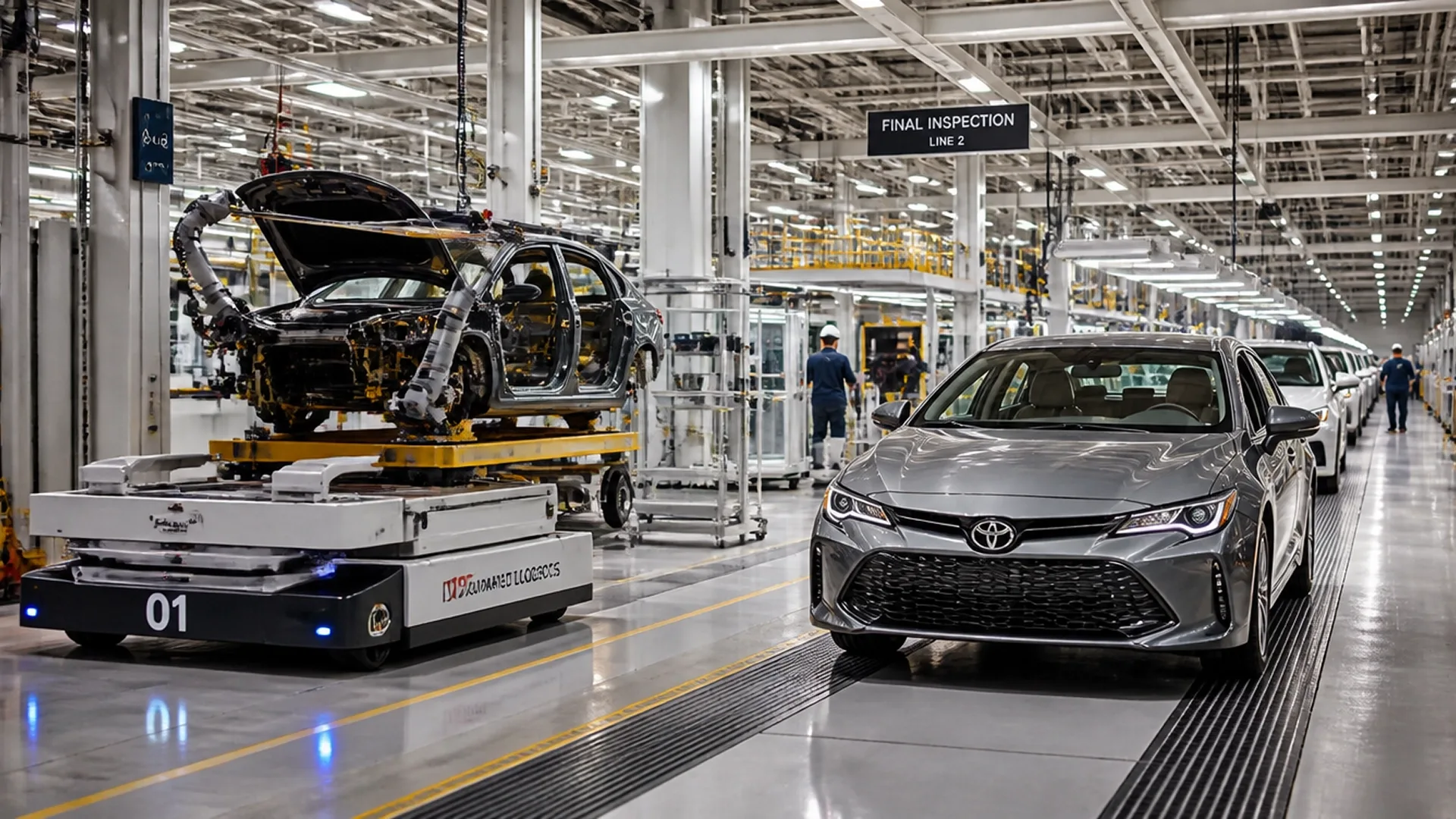
Top Ten Vehicle Manufacturers
Rank |
Manufacturer |
Volume (in millions) |
Top Brands |
|---|---|---|---|
1 |
Toyota |
11.3 |
Toyota, Lexus, Daihatsu |
2 |
Volkswagen |
9.0 |
VW, Audi, Porsche |
3 |
Hyundai |
7.2 |
Hyundai, Kia, Genesis |
4 |
General Motors |
6.2 |
Chevrolet, GMC, Buick |
5 |
Stellantis |
5.4 |
Jeep, RAM, Dodge |
6 |
BYD |
4.6 |
BYD, Denza, Fang Cheng Bao |
7 |
Ford |
4.4 |
Ford, Lincoln |
8 |
Honda |
3.6 |
Honda, Acura |
9 |
Geely |
3.3 |
Geely, Volvo, Polestar |
10 |
Suzuki |
3.2 |
Suzuki, Maruti Suzuki |
Location, Location, Location
The old real estate adage that location is the primary factor in determining a property's value also applies to vehicle manufacturing. Auto manufacturers face the complex challenge of determining the best car manufacturing countries for their various vehicle lines. Trade policies, tariffs, and other political factors always come into play, yet companies generally prefer to make cars where they sell them, since making them in-country helps avoid certain duties and tariffs.
The problem is that a particular model's sales volume does not justify building an assembly plant in each country where the model is sold, so they locate the assembly plant in one country and ship much of its product to other countries.
The need to ship new and used vehicles from one country to another and over long distances within countries like the United States results in the auto transit industry playing a major role in distributing automotive products across the globe and within countries.
Importing Personal Vehicles into the U.S.
There are several situations in which individuals seek to import vehicles from other countries into the United States. Doing so is highly restricted, as vehicles less than 25 years old must comply with all U.S. emissions, safety, and other requirements.
Conforming vehicles bear a label indicating their conformance to the U.S. standard at the time of manufacture, making them easy to identify. Vehicles that do not bear this label are very difficult to bring into the country and those that enter are subject to strict annual mileage limits.
Let's look at several situations in which individual Americans seek to import vehicles into the U.S. and the challenges of getting them from overseas to their destinations.
Standard International Transit Timelines and Port Congestion Factors
Individual vehicles from Europe or East Asia are shipped to the U.S. using the same method as cars imported by manufacturers: roll-on/roll-off cargo ships. Vehicle shipments from Europe to the U.S. typically take 15-25 days; from East Asia to the U.S. West Coast, the same amount of time; and from East Asia to the U.S. East Coast, 30-45 days.
Although U.S. ports experience congestion from time to time, most ships wait only a few days to load and unload after arriving at their destinations, so port congestion tends not to be an issue.
Customs Clearance and Compliance Documentation Complexity
People sometimes purchase vehicles abroad and ship them to the United States. The complexity of customs and other issues largely depends on the nature of the vehicle being imported, as most vehicles must conform to U.S. emissions and other regulations.
The simplest process applies to cars participating in European delivery programs. Several manufacturers allow Americans to buy a new U.S.-conforming vehicle through a U.S. dealer while taking delivery of the car in Europe. The customer drives the vehicle while vacationing in Europe, after which the manufacturer ships the car to the U.S. (A comparable program does not exist for cars in Japan, since their domestic vehicles are right-hand drive and not consistent with U.S. standards.) The European vehicle program cars are U.S.-conforming, and the manufacturer handles the customs process, so the burden on the buyer is limited.
You can also buy vehicles outside the country that do not conform to U.S. standards, but many restrictions keep these cars out of the country until they are 25 years old, at which point the standards are waived. However, while a 25-year-old vehicle can enter the country, it can still be difficult to register the car in states like California due to their stricter emissions laws.
Recommended Shipping Method for High-Value Vehicle Segments
When shipping high-value vehicles from overseas, many depend on specialist firms such as Cosdel, Schumacher, and others. These firms focus on very high-end vehicles being added to customer collections and displayed at collector car events.
These firms ship cars from overseas by air and in specialist cargo containers and provide customs brokerage services.
Specialized Carrier Availability for Luxury and Performance Models
Specialist carriers in the U.S. cluster in major port cities and often serve customers in their region or those seeking delivery to a specific port.
Specialized carriers typically confirm their quotes within a few days. Still, unless the vehicle will travel by air, it can take several weeks to consolidate multiple vehicles into a shipping container and secure a spot on a ship traveling from the home to the destination port.
Domestic Door-to-Door Delivery Infrastructure and Final-Mile Tracking
Once the vehicle passes through the U.S. port, the vehicle must be transported to the owner. Assuming the car is a high-value vehicle and will be shipped to its destination, it should be shipped via an enclosed carrier.
Open carriers do not offer protection against hail, road debris, vandalism, or other potential threats to your vehicle. Although enclosed carriers cost more, most customers consider them worth the price for special vehicles and for those valued at more than $75,000.
Global Vehicle Logistics Requirements by Manufacturing Region
Manufacturing Region Hub |
Western Europe |
East Asia |
North America |
|---|---|---|---|
Standard International Transit Timelines and Port Congestion Factors |
15-25 days; U.S. ports have limited waits |
15-25 days to West Coast; 30-45 days to Gulf and East Coast; U.S. ports have limited waits |
Rail and truck within North America |
Customs Clearance and Compliance Documentation Complexity |
Easy if U.S.-conforming or 25+ years old |
Japanese delivery does not exist; easy for 25+ years old cars |
Easy for U.S. conforming cars imported from Canada or Mexico |
Recommended Shipping Method for High-Value Vehicle Segments |
Specialist auto transporters are norm |
Specialist auto transporters are norm |
Not applicable |
Specialized Carrier Availability for Luxury and Performance Models |
Good availability |
Good availability |
Not applicable |
Domestic Door-to-Door Delivery Infrastructure and Final-Mile Tracking |
Enclosed carrier recommended |
Enclosed carrier recommended |
Enclosed carrier recommended |
Nexus Auto Transport can help those interested in importing a vehicle into the U.S. Since our services cover all 50 States, we work with international partners to coordinate bringing your car into the U.S., and we use our U.S. network of car carriers to deliver the vehicle to your destination.
If you have any car shipping questions or want to learn more about how we can help, feel free to contact us today.
Instant Quote
https://nexusautotransport.com/car-shipping-calculator/
FAQs
How do vehicle manufacturing origins influence international shipping regulations and import duties?
The state of international trade remains in turmoil at the time of this writing, so it is difficult to make definitive statements about these issues. The most solid ground is that U.S. policies limit the importing of cars made in China are unlikely to change soon. Trade issues with Japan, Europe, Canada, and Mexico are more dynamic and difficult to predict.
What specific documentation is required when transporting a newly purchased foreign vehicle across borders?
Rather than name the dozen or so specific forms you may need, I’ll list groups of forms, including:
- Proof of ownership and value
- Transport and security filings
- Federal agency declaration forms (DOT, EPA)
- Customs and Border Patrol forms
- Evidence of vehicle eligibility
Additional information is available on various U.S. government agency websites, including those of the EPA, NHTSA, and CBP.
Do luxury or performance vehicle classifications require specialized enclosed auto transport carriers?
While enclosed carriers are not required for performance vehicles, they are highly recommended for the additional protection they provide against weather-related issues, road debris, and vandalism.
What is the estimated timeline for cross-border shipping from major automotive hubs like Japan or Germany?
It normally takes 15-25 days for the ship to travel from East Asia to the West Coast and from Europe to the East Coast. Traveling from East Asia to an East Coast or Gulf port takes an additional 15-20 days.