

When you enter a dealership to trade in your car, try to sell a car privately, or apply for an auto loan, one or more of the auto industry’s major pricing guides will likely shape the car’s estimated value. Kelley Blue Book, NADA Guides, Black Book, and Edmunds collectively define how the American automotive market sets a used car price.
Yet, despite each being used to define a car’s worth, each answers the question using different tools, different inputs, and different audiences in mind. The final car book value differs for each tool. Understanding how each vehicle valuation method works and for whom can sharpen your negotiating position when involved in a vehicle transaction.
Kelley Blue Book: The Consumer Standard
Kelley Blue Book has been part of American car culture since 1926, when Les Kelley, a California dealer, began tracking the prices of vehicles passing through his lot. What began as an internal dealer project evolved into an industry powerhouse and trusted source, so consumers often want to know the Blue Book value of my car.
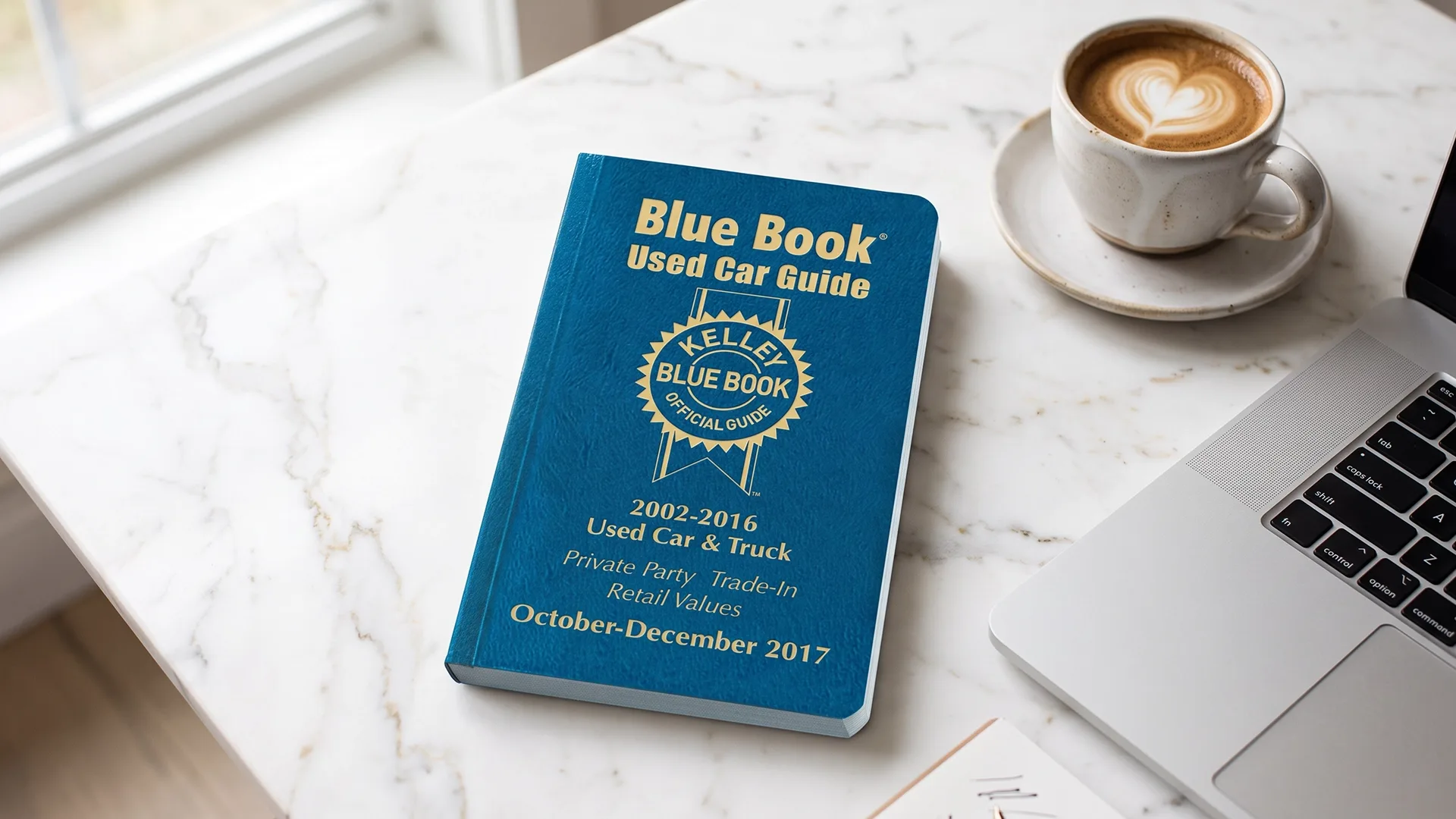
Acquired by Cox Automotive in 2010, KBB's data sourcing is notably wide-ranging. The platform uses data from millions of transactions covering:
Dealership transactions
Wholesale auction results
Private-party sales
Fleet and manufacturer data
KBB updates its prices weekly, factoring in information such as:
VIN decoding
Condition (buyer’s grade of excellent, good, fair, or poor)
Mileage (compared to national averages)
Location
Seasonal shifts, fuel prices, and economic conditions
Local inventory levels
Pickup trucks command different prices in Boston than in Kansas. KBB's system accounts for those differences, allowing a consumer to answer the question, What is the Blue Book value of my truck?, regardless of their location.
KBB's primary audience is consumers who want to understand the value of a vehicle they are interested in buying or selling. However, other groups that use KBB are:
Banks and credit unions: calculate vehicle values when making auto financing loans.
Insurance companies: apply KBB values when handling total-loss claims.
Dealerships: display KBB trade-in estimates on vehicles, a source consumers trust, as a starting point for negotiations.
Since groups use KBB information for different purposes, they provide their pricing four ways:
Private party value: private party sale price
Trade-in value: what a dealer might offer
Dealer retail value: the used car price on a dealer lot
Certified pre-owned value: asking price for cars in manufacturer-backed CPO programs.
This range of information offers versatility for consumers involved in different types of transactions.
NADA Guides: The Retail Industry Benchmark
The National Automobile Dealers Association, the primary dealer organization in the U.S., launched its pricing guide in 1933. For most of its history, NADA was not a consumer tool, but was used by dealers, banks, and fleet managers to determine a vehicle's worth. J.D. Power now manages the process under the NADA Guides brand name.

The data behind NADA Guides comes primarily from the wholesale side of the automotive business. They use:
Hundreds of thousands of monthly transactions from wholesale auto auctions (where dealers buy and sell inventory among themselves)
Franchised and independent dealership sales
Manufacturer pricing information
Using wholesale information gives NADA authority among dealers and auto industry insiders because their numbers reflect what dealers have paid to acquire specific vehicles.
NADA's methodology generally assumes the vehicle being valued is in good, clean condition, so its valuations tend to run higher than platforms that build in condition discounting. While NADA adds rough, average, and clean ratings, it tends to produce more optimistic valuations.
Among NADA's primary users are:
Dealers, when negotiating with customers on trade-ins
Banks and credit unions, when making loan decisions
NADA does not provide a private-party value. Consumers using NADA should use it as the upper bound of what their vehicle might be worth, which can be a useful counterweight to a low dealer offer.
Black Book: The Wholesale Insider
Black Book is not well known among consumers. Published by National Auto Research, part of the Hearst Autos portfolio, Black Book is a subscription service priced for commercial users that starts around $65 per month and is integrated into dealership management software platforms.
The data behind Black Book comes from:
Prices at weekly wholesale auto auctions across the country
Captured by analysts attending the auctions
The resulting dataset is among the most current and granular representations of wholesale market conditions available in the industry.
Black Book combines the auction values with vehicle history data from AutoCheck, so it accounts for a vehicle's:
Reported accident history
Odometer readings
Ownership record
Physical condition
Regional demand
With the platform calibrated around auction transactions rather than retail figures, its numbers are generally lower than KBB or NADA. For dealers, the ideal is to buy at the Black Book wholesale price and retail at KBB levels.
Black Book's primary audience is dealers and lenders who need to know a vehicle's worth in the wholesale market. That focus makes a car’s book value within Black Book’s process valuable for industry insiders, even if it is unknown among the buying public.
Edmunds: The Research-First Consumer Platform
Edmunds entered the automotive information arena in 1966 as a publisher of printed car buying guides. Historically, it has emphasized editorial content such as reviews, expert analysis, and comparisons, so it approaches vehicle valuation as one part of the broader consumer auto research experience. Edmunds is for consumers who want to know more than the Blue Book value of my car, but want to know why it carries that value.
The platform's signature car book value tool is True Market Value, or TMV, which seeks to identify what buyers in your local market pay for a particular vehicle today.
TMV draws on transaction data from:
Consumers
Dealer sales records
Depreciation modeling
Regional pricing information
Their goal is to give consumers a target price for negotiation, typically below the sticker price.
Edmunds offers the same valuation categories as KBB: trade-in, private party, dealer retail, and certified pre-owned. They include condition assessments and mileage adjustments. However, the platform's deeper value is its editorial content:
Expert reviews
Owner ratings
Cost-of-ownership calculators
Dealer inventory search tools
The target audience is the individual car buyer preparing to make a major purchasing decision. Edmunds also attracts sellers who want to price private listings accurately and trade-in customers who want information in hand when arriving at the dealership. Industry professionals less often use Edmunds.
Use the Right Tool for Each Job
While the four platforms compete with one another at some levels, each focuses on different elements of the car-selling and buying processes to answer questions for consumers and industry professionals. The key to using these tools is to be clear on the question you are asking so you know which source to use within the car-buying or selling process.
Of course, when buying or selling vehicles, particularly vehicles located in another state, you may need an auto transport provider to ship them to your home or business. Nexus Auto Transport is among the country’s leading vehicle transport services, so contact us today to learn about our service or obtain a quote.
Instant car shipping quote: https://nexusautotransport.com/car-shipping-calculator/
Auto Valuation Tools Comparison
Valuation Standard | Primary Data Source | Target Audience | Best Used For |
Kelley Blue Book | Retail and wholesale transactions | Consumers | Consumers buying or selling a used car |
NADA Guides | Retail and wholesale transactions | Dealers and lenders | Understanding prices paid by dealer |
Black Book | Wholesale auction transactions | Dealers and lenders | Vehicle value at wholesale |
Edmunds | Retail transactions, consumer input | Consumers | Understanding the whys behind car values |
FAQs
How long is an online car valuation considered valid by most dealerships?
Used car values are dynamic, shifting with industry and world news and consumer attitudes. In addition, those who provide online valuations have a vested interest in consumers making quick decisions, so online car valuations typically remain valid for 7 days. For example, CarMaxx and KBB apply 7-day windows to their offers.
Do aftermarket modifications increase or decrease my vehicle's market estimate?
Aftermarket modifications can increase or decrease a vehicle’s estimate based on what was modified, who performed the modification, and how well they executed it. Modifications that negate the vehicle warranty generally have a clear negative impact. Vehicles are generally valued for their appeal to the general population, not the enthusiast, so while beauty is in the eye of the beholder, modifications often negatively impact valuation.
Should I pay for a physical appraisal before selling to a private party?
Generally, no. For most vehicles, the cost of hiring an appraiser to inspect your vehicle is not offset by an increased sale price. For most sellers, determining the Blue Book value of my truck is enough information to set a fair price. Besides, if the buyer is willing to pay for an appraisal, they generally want it performed by someone they hire, not the seller.
Physical appraisals can have value for some high-value or exotic vehicles, but generally physical appraisals are a cost sellers can avoid.
Does transporting a vehicle across state lines impact its overall resale value?
The resale value of a vehicle can go up or down when moving across state lines. Some vehicles are in greater demand in one state than another, so a vehicle's value can rise or fall depending on the states it leaves and enters.
On the other hand, vehicles sometimes are moved across state lines for title washing purposes. Titling requirements differ from state to state, so some bad actors register vehicles in a new state to hide aspects of a vehicle's history.