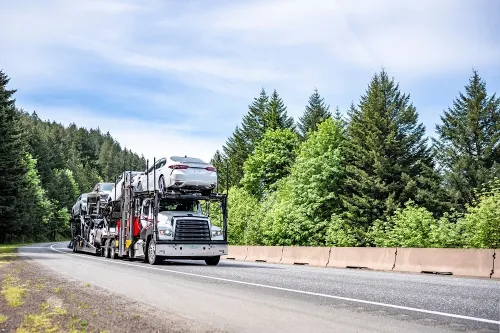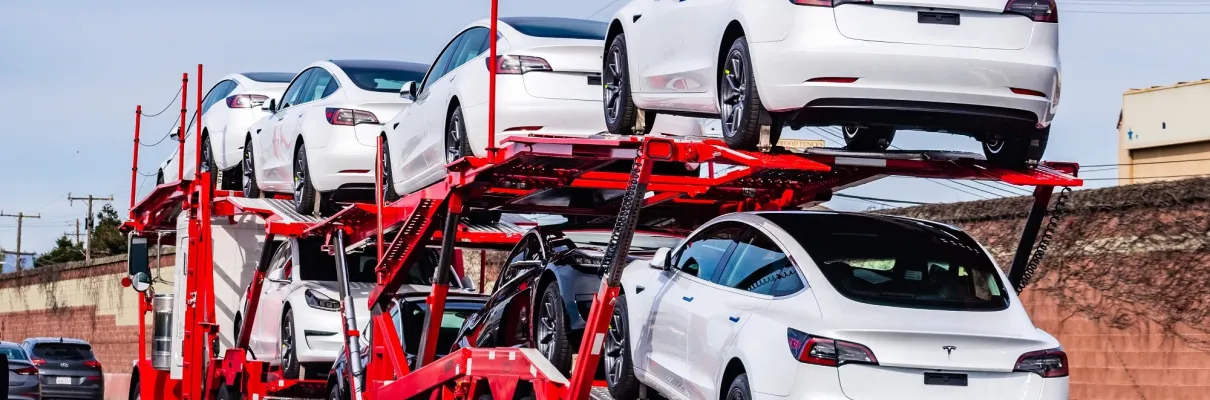

Ask anyone in the business about car shipping time estimates, and they’ll give you a time range rather than a specific number of hours. Their answers are not evasive. Instead, they are being realistic because transit times are affected by federal driver fatigue rules, traffic, weather systems, and the pickup and delivery needs of the other vehicles riding on the trailer with your car.
Distance sets the baseline for trip timing, while other factors determine how far the delivery strays from standard estimates of auto transport time by distance.
The Baseline: Auto Transport Time by Distance
Car haulers typically drive 400 to 500 miles per day in practice. All route timing estimates start there, and produce the following estimates for routes of varying distances:
- <500 miles: 1 to 3 days
- 500 to 1,500 miles: 3 to 5 days
- 1,500 to 2,000 miles: 5 to 7 days
- >2,000 miles (coast to coast): 7 to 10 days
The average miles per day improves on longer routes because certain fixed tasks take up a smaller percentage of the trip time. For example, a 10-vehicle 300-mile hop and a 2,500-mile haul from New York to California require the same time to load the vehicles and handle paperwork, so longer trips are more efficient and predictable.
The public may be surprised by the limited miles truckers drive per day because they've likely driven longer distances in one day in a passenger vehicle. However, a loaded 80,000-pound car hauler with loading stops built into the day cannot manage more miles, and federal law ensures that's the case.
The Hours-of-Service Ceilings
Beyond the need to drive long distances, the main constraint on how quickly trucks cross the country is the time limits drivers operate under. These rules impact timing and safety, so they are worth covering in depth.
The Federal Motor Carrier Safety Administration's hours-of-service rules limit drivers:
- A max of 11 driving hours after 10 consecutive hours off duty
- No more than 14 consecutive working hours
- Must take a 30-minute break after eight cumulative driving hours
Besides the daily limits, they have weekly restrictions as well:
- Driving capped at 60 hours in 7 days or 70 hours in 8 days
- Resets after 34+ consecutive hours off
These restrictions on drivers, combined with terminals and fuel stops, plus traffic, result in a 50-MPH average that yields 550 miles on a perfect 11-hour day. Loading and unloading take time, so 400 to 500 miles becomes the working average.
- Coast-to-coast runs bump up against the weekly limit. A driver running hard for five days approaches the 70-hour wall and must take the 34-hour restart, effectively parking your car for a day and a half.
- Team drivers can bypass these barriers, which is why expedited cross-country service exists and costs more.
- Electronic logging devices record duty status automatically, so drivers cannot "make up time" by pushing past the limit.
Traffic in Metro Areas
Congestion costs the trucking industry $108.8 billion or 1.2 billion hours of delay per year. For your shipment, congestion affects the speed and distance traveled on a Los Angeles-to-Atlanta run that goes through Houston and Dallas. Then urban delivery adds difficulty. Narrow streets, low-hanging branches, and tight turns can cause trouble. After all, trucking terminals and warehouses are built along the highways to avoid congestion.
Rural addresses cost time for the opposite reason. They're off the carrier's interstate lane, so the truck may wait until a second nearby delivery makes the detour worthwhile.
Seasonal, Regional, and Unpredictable Weather
The Federal Highway Administration says snowy or slushy pavement cuts average arterial speeds by 30 to 40 percent. Freeway speeds drop 5 to 40 percent in heavy snow, which can cause timing problems on the Denver-to-Chicago run in January.
Drivers can extend their 11-hour driving limit and 14-hour windows by 2 hours under adverse driving conditions. While these extensions help, they often don't make up the time lost.
Other Factors Affecting Car Shipping Timeframes
In addition to federal restrictions on driving time, traffic, and weather, other timing factors include:
- Dispatch time is not transiting time. The time between carrier assignment and vehicle pickup is typically 1 to 5 days but can take longer on low-volume routes. Popular corridors like Florida-to-Northeast fill up fast, while a shipment from rural Montana may wait a week for a truck heading that direction.
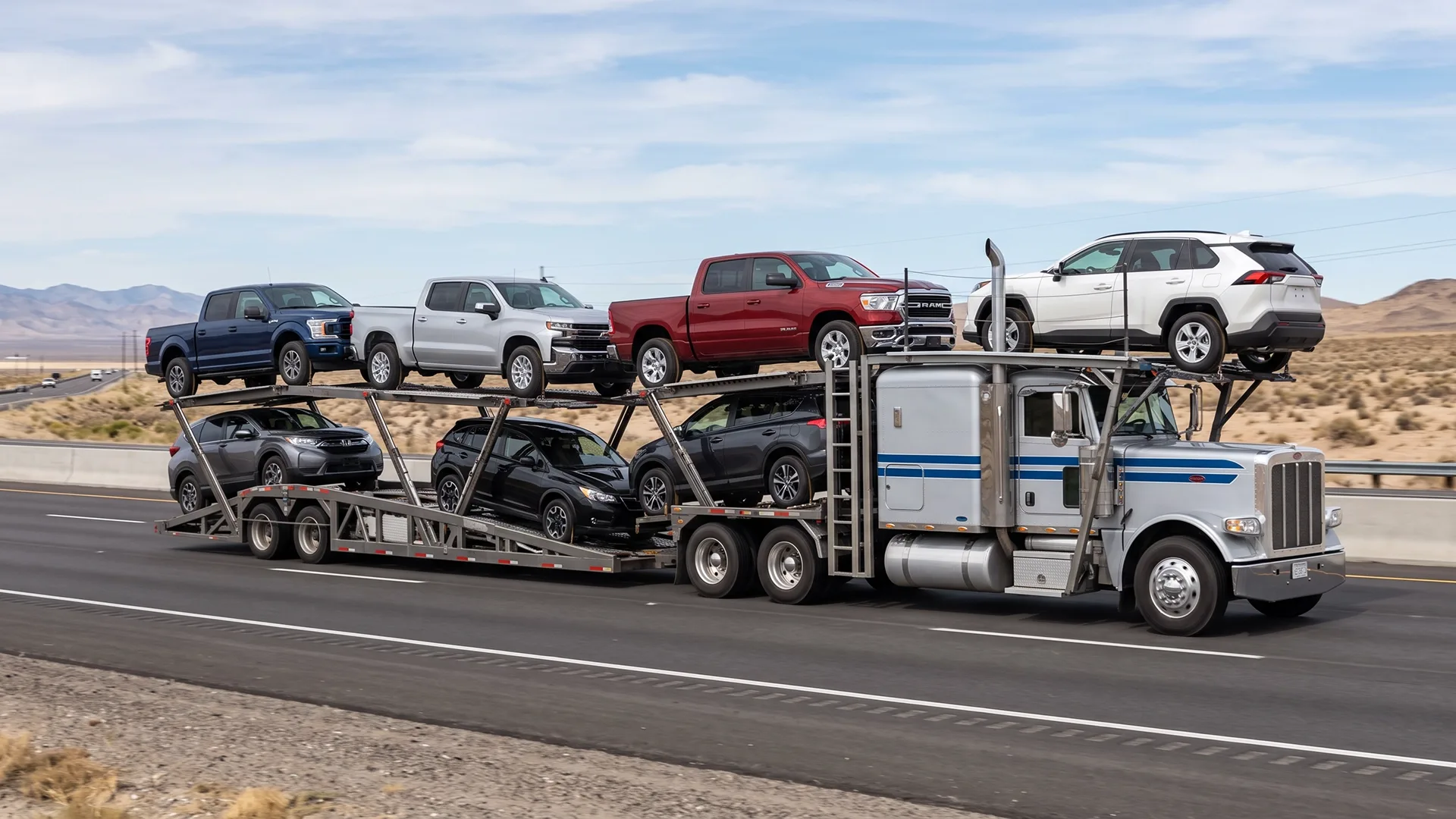
- Load sequencing. Your car is one of eight to ten on the trailer. Every additional pickup and drop adds about half a day. Your car may be loaded first and delivered last to achieve route efficiency, regardless of whether you booked first or last.
- Seasonality. Snowbird migrations (north to south in fall, reversed in spring) and May-through-August family relocations strain the system, tighten capacity, and add a day or two to your timeline.
- Mechanical and regulatory friction. Mechanical breakdowns, weigh station inspections, and roadside enforcement stops consume portions of the 14-hour clock, and your vehicle does not move a mile during those events.

How You Can Help Yourself
Knowing the factors affecting car shipping time estimates, you can help yourself by:
- Booking two to three weeks ahead
- Treating quoted delivery timing as a window, not an appointment
- Considering team-driver expedited service if you have a hard deadline
Understanding and executing vehicle transport is our core business, so we know the ins and outs of scheduling auto transport shipments efficiently.
As a leading broker, Nexus Auto Transport has a nationwide network of vetted carriers experienced in all aspects of vehicle transfers. Contact us for a quote and see how our 3-step process makes it easy for you from start to finish.
Instant Quote: https://nexusautotransport.com/car-shipping-calculator/
Estimated Car Shipping Time by Distance
Shipping Distance |
Estimated Transit Time |
Typical Route Type |
Factors That May Extend Delivery |
|---|---|---|---|
0 to 500 miles |
1 to 3 days |
Regional; single state or neighboring states, may use secondary highways |
Short hauls carry the least schedule cushion; one slow dispatch day is a third of the trip; waiting to assign a carrier is the usual delay, not drive time |
501 to 1,000 miles |
2 to 4 days |
One or two interstate corridors (Chicago to Atlanta) |
Two driving days minimum under the 11-hour limit; congestion at either end and multi-car load sequencing add hours. |
1,001 to 1,500 miles |
3 to 6 days |
Multi-state interstate run with intermediate pickups |
Whether your vehicle was loaded first or last affects timing; weigh-station inspections and regional weather matter |
1,501 to 2,000 miles |
5 to 7 days |
Long-haul interstate |
Solo drivers approach the 60 to 70-hour weekly cap; mountains (I-70, I-80) and seasonal demand can add a day |
2,001 to 2,500 miles |
6 to 9 days |
Near coast-to-coast (Dallas to Seattle, Miami to Denver) |
34-hour restart likely for a solo driver; winter storms and chain requirements compound it. |
2,500+ miles |
7 to 10+ days |
Full coast-to-coast (New York to California, Florida to Washington) |
1+ mandatory restart unless team drivers; hurricane and snow seasons; rural endpoints, push timing past 10 days. |
FAQs
Does pickup or delivery in a rural area increase car shipping time?
Yes. The main impact comes during dispatch, not during transit. Carriers want to be efficient, so they prefer vehicles along major routes over those farther away.
Does the type or size of the vehicle affect car shipping time?
Your vehicle's size doesn't affect the truck's speed, but it strongly affects how quickly you're assigned to one. A standard sedan fits any slot on any trailer. A lifted truck, dually, or extended-length SUV occupies two positions and pushes against the federal 80,000-pound GVW limit, so the driver must plan the rest of the load around it.
Can enclosed auto transport take longer to schedule than open transport?
Yes. Enclosed carriers are far less common than open ones, and enclosed trailers haul 2 to 7 vehicles versus an open carrier's 7 to 10. Fewer trailers carrying fewer cars means fewer scheduling options and longer wait times.
Does expedited car shipping guarantee an exact delivery date?
Seldom, and only when you pay extra for a guaranteed delivery date. Most expedited services primarily offer priority dispatch, meaning you get a tighter or guaranteed pickup window, not a guaranteed delivery date. Expedited services that use team drivers can sidestep the 10-hour off-duty reset, which helps reduce transit time on long-haul routes.