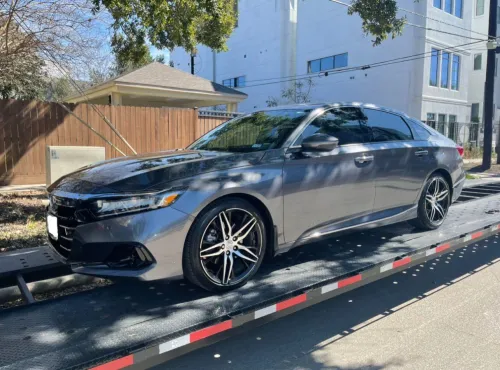
When carriers and brokers determine their price to transport a vehicle, the distance the car will travel is a key part of the calculation, but so are the vehicle's size and weight. Understanding why size and weight matter makes it easier to recognize why you pay more for your full-size pickup than your neighbor who is shipping a compact sedan.
Without knowing the impact of your car’s size and weight, you might have a different expectation for what shipping you’ll pay. That’s why getting multiple quotes can be a real advantage. Here’s some background on how car size, shape, and weight impact different shipping rates.
Do Larger Vehicles Cost More to Ship?
Every car hauler operating on U.S. highways is bound by federal weight limits under 23 CFR Part 658, which sets a maximum gross vehicle weight (GVW) of 80,000 pounds for a tractor-trailer combination on the Interstate Highway System. The ceiling is not negotiable, and applies to the combined weight of the tractor, the trailer, and the vehicles loaded on it.
A typical open nine-car hauler, the type you see rolling down the highway stacked two rows high, weighs roughly 35,000 to 40,000 pounds empty. That leaves approximately 40,000 to 45,000 pounds of payload capacity to divide among the vehicles on the trailer.
Do the math and the constraint becomes clear. A typical sedan weighs 3,500 pounds, while a three-quarter-ton pickup or a large SUV tips the scales at 6,500 to 7,500 pounds. So, do larger vehicles cost more to ship? Yes, and that is the case because larger vehicles consume a higher share of the legal payload. It requires the driver or carrier to leave one or two slots empty to stay under the maximum weight.
When a carrier is unable to fill all the slots on the trailer, they try to recover some of the lost revenue by charging more for the heavier vehicle. That explains why heavier vehicles carry a $100 to $300 surcharge over the base rate on comparable routes.
Weight Distribution and Axle Loading
Besides total weight, federal regulations also cap the weight on individual axle groups. Single axles are capped at 20,000 pounds and tandem axles at 34,000 pounds. There are bridge formulas restricting how the weight can be distributed across all axles.
Having a heavy vehicle positioned on the wrong slot on the trailer can push one axle group over its limit, even when the overall GVW is fine. In effect, loaders must solve the weight distribution puzzle by positioning heavier vehicles over the rear axle group and lighter ones on the upper deck near the front.
From the shipper's standpoint, this explains why two vehicles of the same weight may have different prices if one creates a placement problem that complicates a load. Likewise, since two carriers are solving different puzzles, you might get different prices from two carriers for the same vehicle.
Trailer Slots and Physical Footprint
Beyond its weight, a vehicle's physical dimensions govern whether or where it fits on the deck. A standard open nine-car trailer is designed around vehicles that are 16 to 18 feet long and 5 feet tall. Sedans, coupes, and crossovers generally fall within those limits. However, extended-cab long-bed pickups, large vans, and full-size SUVs push these limits and can keep the carrier from loading a ninth vehicle onto the truck. Again, fewer billable slots mean higher per-vehicle rates.
Enclosed transport is even more sensitive. A standard enclosed trailer holds six to eight vehicles in a shorter, more constrained space. Wide-body vehicles, vehicles with roof racks, or anything approaching the 7-foot height threshold can cause slot conflicts that push the shipper into a larger enclosed unit — often at a meaningfully higher price.

Ground Clearance and Loading Risk
Ground clearance also affects which position a vehicle can occupy. Multi-level car haulers use hydraulic ramps that are adjustable to create acceptable angles, but they have limits. A vehicle with fewer than 4 inches of clearance risks bottoming out on the ramp transition. Carriers are fully aware of this liability since a damaged undercarriage on delivery is the carrier's financial and legal problem.
The result is that low-clearance vehicles are often restricted to upper-deck positions (which have shallower ramp angles) or may require an enclosed carrier with a lift-gate or drive-on ramp designed for low-slung cars. Both options cost more. Some carriers decline to book a vehicle with less than 3.5 inches of clearance unless the shipper arranges specialty equipment.
Toll and Bridge Weight Limits
Carriers planning routes for full loads must account for bridge and toll road weight restrictions. While bridges are often designed for the federal 80,000-pound GVW, routes that use older infrastructure can face lower weight limits, some even as low as 40,000 pounds. That means a fully loaded nine-car hauler cannot travel that route.
When a route lacks alternatives, the carrier either must split the load, deadhead a partial trailer, or go around that infrastructure. That cost flows to the customer as a regional surcharge, which helps explain why big trucks are more expensive to ship, and rural pickups and deliveries cost more than metro-to-metro moves of comparable mileage.

Modified Vehicles: Where Every Variable Gets Harder
A truck with a lift kit, oversized tires, and a roof-mounted light bar can exceed the height limit for enclosed trailers, cause position conflicts on open carriers, and its aftermarket accessories can result in a weight surcharge.
Carriers are open to shipping modified vehicles. They do it regularly, but they need accurate measurements about the truck. Misrepresenting a vehicle's height, weight, or configuration can result in a carrier arriving at pickup and being unable to load the vehicle, with cancellation fees falling on the shipper.
For any vehicle that has been meaningfully altered from its stock configuration, the right move is to call the carrier directly, provide actual dimensions and curb weight with modifications, and confirm the rate before booking.
The underlying principle running through all these variables is the same: every pound and every inch either fit within the carrier's operational envelope at standard cost or force a workaround, which is why big trucks are more expensive to ship.
How We Help with Your Vehicle Transport
Understanding and executing vehicle transportation is our business. As a leading broker, Nexus Auto Transport has a nationwide network of vetted carriers who understand and are experienced with all types of vehicle transfers. Contact us for a quote, as our 3-step process makes it easy for you from start to finish.
Instant Quote: https://nexusautotransport.com/car-shipping-calculator/
Vehicle Size and Weight Impact on Shipping Cost
Vehicle Category |
Weight Range |
Dimensions |
Relative Cost Difference |
|---|---|---|---|
Compact Sedan |
2,800 to 3,500 lbs. |
~14 to 16 ft long ~5.5 to 6 ft wide ~4.5 to 5 ft tall |
Baseline (standard rate) |
Medium Crossover |
3,500 to 4,500 lbs. |
~15 to 16.5 ft long ~6 to 6.5 ft wide ~5.5 to 6 ft tall |
+5 to 10% over baseline |
Full Size Pickup Truck |
4,500 to 7,000 lbs. |
~17 to 22 ft long ~6.5 to 7 ft wide ~6 to 6.5 ft tall |
+15 to 30% over baseline |
Large Commercial Van |
5,500 to 8,550 lbs. |
~18 to 20 ft long ~6.5 to 7 ft wide ~7.5 to 9.5 ft tall (high roof) |
+25 to 40% over baseline May require specialty carrier placement |
FAQs
Do aftermarket modifications like a lift kit or roof rack increase the final shipping rate?
Yes. The practical rule is this: if the modification changes the vehicle's height, length, width, weight, or clearance by more than an inch or a couple hundred pounds, call the carrier directly before booking and give them the actual measurements.
Showing up at pickup with undisclosed modifications can result in the carrier refusing to load the vehicle and cancellation fees that you pay.
How do auto transport carriers verify the vehicle weight before loading?
The honest answer is that most of the time, they don't, at least not with formal measurements. At pickup, the driver inspects the vehicle and matches it against what was booked.
Before a driver pulls onto the interstate with a full load, they'll check the rig across a certified truck scale to confirm the total combination weight and axle group weights are within legal limits. If the load comes in over, the driver must figure out which vehicle is the culprit based on axle readings and their knowledge of what's loaded where, potentially leading to leaving a vehicle behind.
Are there weight limits that require a vehicle to be shipped on a specialized flatbed instead of a multi-car carrier?
Yes, though the threshold isn't a single published number. It's more the combination of weight, size, and vehicle type that pushes a vehicle outside what a standard car hauler is designed to handle.
The weight ceiling on a standard multi-car carrier is roughly 7,000 to 8,000 pounds for a single vehicle. A heavily modified full-size truck with lots of aftermarket accessories can approach or exceed that range.