

A commercial move is not a household move with more boxes. It is a construction-adjacent project with a hard deadline, a landlord on each end, a payroll running the whole time, and almost none of the federal consumer protections that cover a family moving across state lines apply to commercial moves.
The 19 facts below cover what commercial moving companies do, their costs, governing rules, and how to identify capable firms.
What Commercial Movers Do
1. “Commercial moving” is a project-management business that owns trucks.
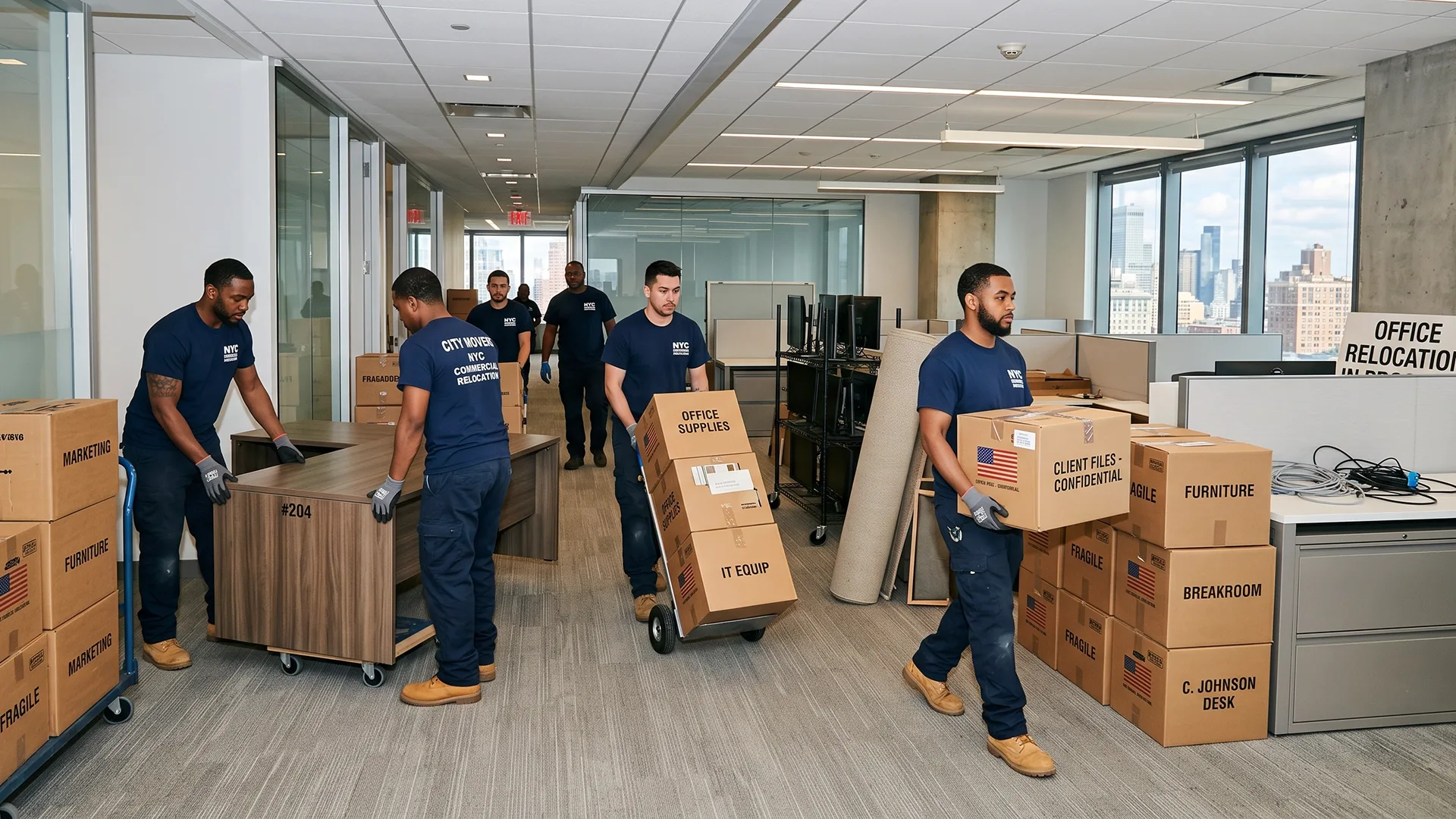
The trucking is the least complicated part. A full-service commercial mover sells planning, sequencing, labor, and reinstallation:
- Pre-move surveys of both buildings
- Floor-plan-based labeling systems
- Crews scheduled around building hours
- Furniture teardown and rebuild
Large firms staff the job with a dedicated project manager who is the single point of contact from the survey through the last box. National providers often market the service explicitly around downtime reduction rather than transportation.
2. The service catalog is much wider than “load and haul.”
National commercial moving services include office relocation, warehousing and commercial storage, technology and IT services, records and archive management, furniture installation and reconfiguration, space planning support, and decommissioning, plus industry-specific practices for labs, healthcare, biotech, data centers, and government facilities.
3. Move management can be bought as a standalone service.
Companies that want to keep the physical labor competitive can hire a move consultant or project manager separately to write the scope, run the bid, and supervise execution. On a mid-size move, project management can be a relatively small line item that has a big impact on the others.
4. Specialty verticals are genuinely different trades.
Lab relocation involves chemical inventories, cold-chain equipment, and calibration; healthcare moves involve patient-record chain of custody; data-center moves involve rack decommissioning and re-racking; library and archive moves involve keeping tens of thousands of items in sequence.
Providers market these as separate practices with their own crews and tooling. Factory and heavy machinery moves are another trade, with rigging and millwrighting often subcontracted.
5. Decommissioning is a distinct scope that closes out the old lease.
Vacating space is its own project: inventory and valuation of what is left behind, furniture disassembly and removal, resale, donation or recycling, IT decommissioning with data wiping, degaussing and hard-drive shredding, cable abatement, and restoration of the space to the condition the lease requires.
Cable abatement is not optional housekeeping: the National Electrical Code requires removal of the accessible portion of communications cable that no longer terminates at equipment and is not tagged for future use. Adoption of a given NEC edition varies by jurisdiction, so confirm the local code and the lease language.
6. Reusable plastic crates have largely replaced cardboard on office moves.
Rental crates arrive stacked on dollies, latch without tape, stack without collapsing, and go back to the vendor after unpacking, removing both packing-material purchases and post-move disposal. Rental terms are sized to headcount, with scheduled delivery and pickup windows.
The trade-off is a fixed rental window: crates must be unpacked and returned on schedule, or the rental period and costs extend.
The Rules That Actually Apply
7. Federal household-goods consumer protections do not cover office moves.
This is the single most misunderstood fact in the category. The FMCSA consumer-protection rules about written estimates, the 110-percent rule, mandatory arbitration, and the “Your Rights and Responsibilities” booklet apply only when a carrier transports household goods for an individual shipper. Household goods are defined as “the personal effects or property used, or to be used, in a dwelling.”
Office furniture, servers, and file cabinets are not dwelling property, so a business moving its own premises is an ordinary freight shipper.
8. Relocating an employee is a household-goods move even when the company pays.
The statutory definition covers dwelling property whether the move is “arranged and paid for by the householder” or “arranged and paid for by another party”. An employer-funded relocation of a worker’s home therefore keeps the full protections. The corporate office move happening the same month does not. Companies buying both should not assume one contract governs both.
9. The Carmack Amendment governs commercial moves.
Liability for loss or damage on an interstate commercial shipment runs through the Bill of Lading, which makes the receiving, delivering, and any intermediate carrier liable for the actual loss or injury to the property. The Bill of Lading, not a consumer regulation, is the contract. Read it before the crew arrives, not after.
10. Carmack sets floors on the claim clock, and carriers write to the floor.
A carrier may not provide by rule, contract, or otherwise, a period of less than 9 months for filing a claim against it or a period of less than 2 years for bringing a civil action. Most Bills of Lading adopt exactly those minimums. The two-year window runs from the carrier’s written notice that the claim is disallowed.
11. There are federal rules for how a claim must be handled — and how you must file it.
A written claim must:
- Identify the shipment
- Assert carrier liability
- Demand a specified or determinable amount of money; a damage notation on a delivery receipt does not qualify.
The carrier must acknowledge the claim in writing within 30 days of receipt and must pay, decline, or make a firm compromise settlement offer in writing within 120 days, with written status updates every 60 days after that.
12. An interstate commercial mover still needs federal registration and $750,000 in liability coverage.
Deregulation of the consumer rules did not deregulate the truck. A for-hire carrier hauling non-hazardous property in interstate commerce in a vehicle rated over 10,000 pounds must maintain at least $750,000 in public liability coverage, and its authority, safety record, and insurance filings are public in FMCSA’s SAFER Company Snapshot. That is the first search to run on any bidder.
13. Cargo insurance is not federally required on a commercial move.
FMCSA eliminated the cargo-insurance maintenance and filing requirement for most for-hire carriers effective in 2011, leaving it in force only for household-goods carriers and household-goods freight forwarders. On a commercial move, any cargo coverage exists only because the contract provides it.
14. Valuation on a commercial move is a negotiated contract term, not a regulated menu.
No mandated Full Value Protection option and no required disclosure booklet exists, though movers commonly mirror the household-goods default of 60 cents per pound per article, the free minimum a household mover may offer, worth $6 on a 10-pound item, but nothing compels that number or any other.
Ask for the declared-value option, the deductible, and the exclusions in writing, and check whether your commercial property policy covers goods in transit.
What Commercial Moving Services Cost
15. Commercial moving is priced on labor hours, not shipment weight.
Household interstate pricing runs on weight and mileage. Office pricing runs on crew hours, truck count, and access conditions. The International Office Moving Institute teaches its certified movers an estimating formula based upon man-hours that enables moves to finish on time for the price quoted. Two quotes are comparable only if they assume the same crew size, building access, and amount of disassembly.
16. Published cost ranges are self-reported, and worth treating as a sanity check only.
No government agency or independent auditor publishes benchmark pricing for commercial moves. The estimates below are from pricing aggregators and shouldn't be used for budgeting.
Cost and Labor Estimates by Office Scale
Office Size in Square Feet |
Average Employee Count |
Required Number of Movers |
Estimated Standard Labor Hours |
|---|---|---|---|
Small Scale under 1500 sq ft |
6 to 12 |
3 to 4 movers, 1 truck |
15 to 35 crew-hours; one 4 to 8 hour shift |
Medium Scale 1500 to 3000 sq ft |
10 to 23 |
4 to 6 movers, 1 to 2 trucks |
20 to 70 crew-hours; one long day or two shifts |
Large Scale 3000 to 10000 sq ft |
20 to 77 |
6 to 10 movers, 2 to 4 trucks |
35 to 230 crew-hours; a full weekend, 2 to 3 shifts |
Corporate Scale over 10000 sq ft |
67+ |
10 to 20+ across multiple crews |
115+ crew-hours per 10,000 sq ft; normally phased across several weekends |
17. IT and cabling are the line items that break budgets and are often not in the mover’s base price.
IT and data cabling for a 30-person office can cost $5,000 to $10,000, rising to $ 30,000+ for complex builds. The cost depends on the complexity of your requirements, the quality of your IT documentation, and the differences between the existing and new installations.
18. Building conditions and clock time drive the bid more than distance does.
Elevator availability and reservation windows, loading-dock scheduling, long carries, stair work, protective floor and wall coverings, permitted work hours, and the volume of systems-furniture disassembly all convert directly into crew hours.
Most commercial moves run nights or weekends to avoid business hours, and off-hours labor is priced accordingly. A mover that quotes without walking both buildings is guessing.
How to Identify Quality Commercial Moving Companies
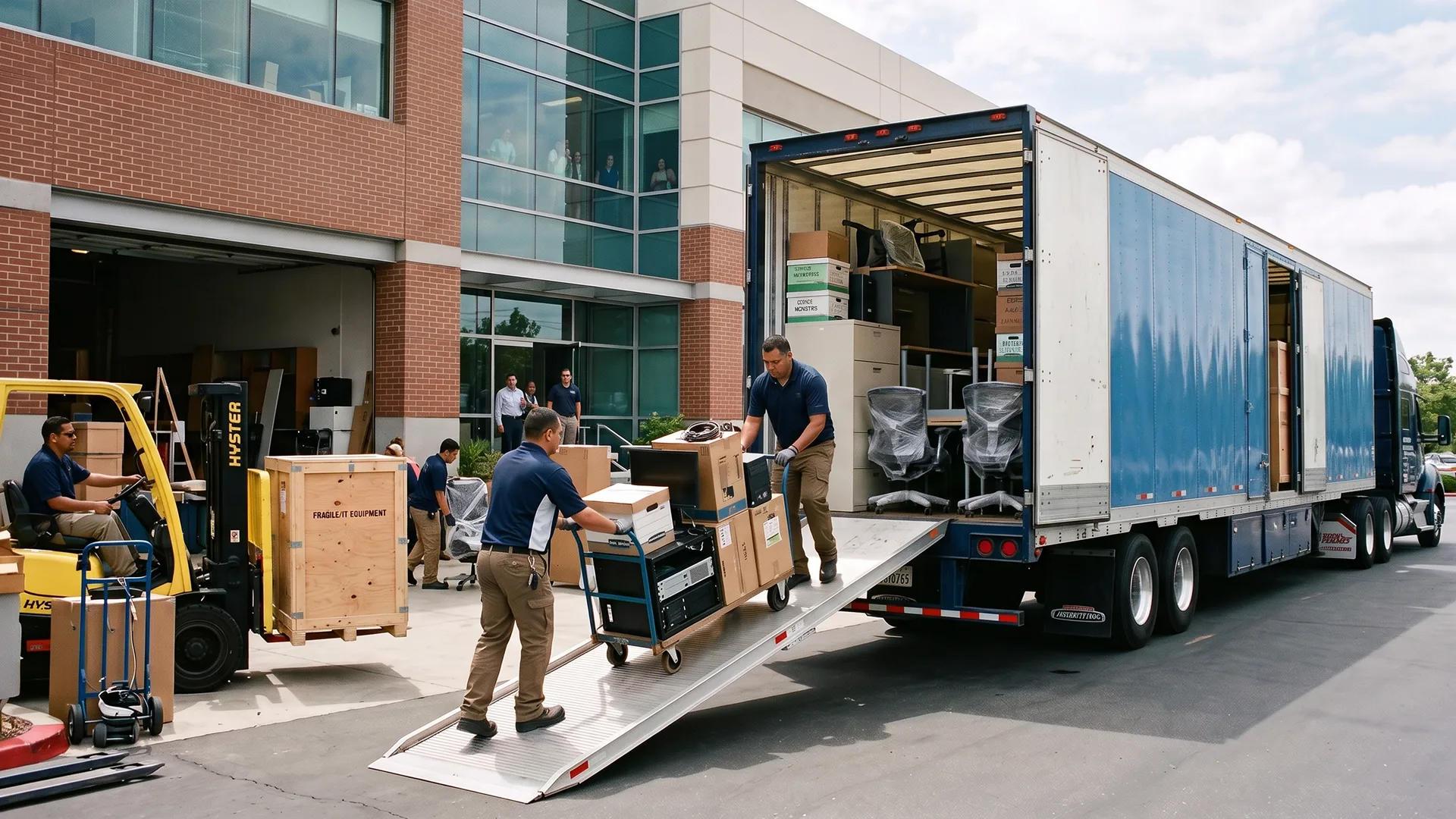
19. Five checks separate a professional commercial mover from a truck rental with a sales team.
- Verify the registration first. Pull the bidder’s SAFER Company Snapshot and confirm active operating authority, the insurance filings on record, the safety record, and that the legal name and address match the proposal. This takes two minutes and disqualifies candidates faster than anything else.
- Look for certifications that require training, not dues. The International Office Moving Institute’s Certified Office Mover designation covers protecting furniture, copiers, and computers; protecting carpet, walls, doors, and elevators; and man-hour-based estimating, and it requires renewal through ongoing training. Manufacturer installer credentials, such as a Haworth or Steelcase certification, matter if systems furniture is being rebuilt. For anything touching records or drives, look for NAID AAA Certification for secure destruction and an R2- or e-Stewards-certified downstream recycler for e-waste.
- Test the certificate-of-insurance process. Nearly every commercial building requires a certificate of insurance naming the owner and property manager as additional insureds, at specified limits, before releasing the freight elevator. Send the bidder your building’s requirements during the bid and see how fast a compliant COI comes back. A mover that fumbles this during the bid will fumble it on move night.
- Demand a written scope built from a walkthrough of both ends. The proposal should name the crew size, truck count, hours, labeling system tied to the destination floor plan, disassembly and reassembly scope, crate count and rental window, who handles IT, and what “complete” means. A single named project manager should own your move.
- Check references from comparable moves. Ask for two or three clients of similar headcount who moved into similar buildings within the past year, and ask those references specifically about schedule adherence, damage claims, and how the punch list was closed. Also ask whether crews are background-checked employees or day labor; on a move that touches every file cabinet in the company, that answer matters.
How Nexus Helps Your Company and Employees Get Where You're Going
Some commercial moves require company fleets or employee-owned vehicles to move from state to state, and managing those processes is our core business. Nexus Auto Transport is a leading broker with a nationwide network of vetted carriers experienced in all aspects of vehicle transfers. Contact us for a quote and see how our 3-step process makes it easy for you from start to finish.
Use our car shipping calculator for a free quote: https://nexusautotransport.com/car-shipping-calculator/
FAQs
How far in advance should a business book a commercial mover?
For a small office of roughly 10 to 20 people, six to eight weeks is usually enough to get competitive bids and a preferred date. For a mid-size office, three months is a safer target. For anything above roughly 100 people, a multi-floor footprint, or a specialty environment such as a lab, data center, or clinic, plan on six months, and start the mover search in the first month of that window.
Three constraints usually set the real deadline.
- Leases. Building managers commonly require three to six months’ notice before you vacate, and the old lease’s restoration obligations (furniture removal, cable abatement, broom-clean condition) take weeks to scope and bid.
- Technology. New-site cabling, circuits, and carrier provisioning have lead times measured in months and are the most common cause of a delayed move date.
- Business calendar. Month-end, quarter-end, and summer weekends are the industry’s peak, and crews with commercial certifications are the first to be committed.
A practical sequence is to sign the new lease, immediately book the walkthroughs, award the move contract at least eight to twelve weeks out for a mid-size job, and hold the physical move date only after the IT provisioning date is confirmed in writing. Booking the mover before the network is scheduled is how companies end up paying for a crew to move desks into a building nobody can work in.
How can a company minimize downtime during a commercial move?
Downtime is a scheduling problem, not a speed problem. The reliable strategies are:
- Move outside business hours. Friday night through Sunday and overnight moves are the industry norm precisely because they buy a full weekend of buffer. Budget for the off-hour’s premium; it is almost always cheaper than lost billable time.
- Phase the move by department instead of moving everyone at once. Relocate one group per weekend so the company is never fully offline, and sequence customer-facing and revenue-generating teams either first (so they stabilize early) or last (so they keep operating longest), depending on which function is harder to interrupt.
- Separate the IT cutover from the furniture move and finish it first. Cable, provision, and test the new site’s network before a single desk arrives. Where budget allows, run both sites in parallel for a few days so the old location stays live until the new one is proven.
- Pre-stage everything that can move early. Archives, dead files, seasonal inventory, marketing stock, and spare furniture can go into the mover’s warehouse weeks ahead, shrinking the critical-path weekend to only what people need on Monday.
- Use a labeling system keyed to the destination floor plan. Every crate, monitor, and chair gets a code that maps to a numbered location on a posted plan. This is what determines whether people are working at 9 a.m. Monday or hunting for their keyboard at noon.
- Publish a first-day plan and staff it. Name a floor captain per department, keep the mover’s crew and an IT team on site through the first business morning for the punch list, and route every issue to one channel rather than to whoever is nearest.
- Let some people work remotely through the transition. For roles that don’t need the building, a two-day remote window turns the riskiest part of the move into a non-event.
The mover’s project manager, IT, facilities, and department leads should agree on the sequence weeks before the trucks are booked. Nearly all move-weekend improvisation traces back to a decision that was not made during the early project planning.
Do commercial movers handle moves between multiple office locations?
Yes, and multi-location work is standard on the commercial line card. Common patterns include:
- Consolidation or several offices collapsing into one headquarters
- Dispersal or one location splitting into several
- Staged floor-by-floor moves inside a single building
- Multi-city portfolio moves executed on a rolling schedule
Two capabilities make it work.
- The first is warehousing: a mover with commercial storage can receive furniture and equipment from three sites on three different weekends and hold it until the destination is ready, turning an impossible simultaneous move into a sequence.
- The second is asset inventory and tracking — barcoded or tagged items with a record of origin, storage location, and destination, so a chair from the closed branch office is findable three weeks later.
What should businesses do before movers arrive on moving day?
By the time the crew shows up, the decisions should already be made. A working checklist:
- Confirm building access at both ends. Ensure the certificate of insurance is accepted and on file, reserve the freight elevator for the specific hours, book the loading dock, arrange after-hours building access, and notify security or property management with the crew list.
- Have the destination ready to receive. Post floor plans at the elevator on every floor, number locations to match the crate labels, clear parking or staging areas, and confirm lights, HVAC, and restrooms are operational for the crew’s hours.
- Finish the packing that is yours. Crate and label personal items, desk contents, and anything outside the mover’s scope before the crew arrives. Crates must be closed and stackable, not half-full.
- Purge and decide first. Shred, recycle, donate, or liquidate before the move rather than paying to transport furniture and paper you will discard in the new space. Route records through a documented destruction process and drives through a certified sanitization or destruction workflow.
- Handle IT and data separately. Complete backups the night before, photograph cable configurations behind equipment, power down and label hardware per the IT plan, and keep servers, network gear, and any device holding sensitive data on the chain-of-custody track rather than in the general load.
- Segregate what is not moving. Tag or physically isolate items to be left, sold, donated, or destroyed, and walk that list with the crew chief.
- Secure the valuables and the paperwork. Keep cash, checks, keys, access cards, small high-value electronics, licenses, and original corporate documents with a named employee, not in the truck.
- Do the pre-move walkthrough with the crew chief and document the condition. Photograph or video existing damage at both buildings and the condition of major assets before loading. Review the Bill of Lading and the inventory before signing.
- Staff the day. Assign a floor captain per department at origin and destination, publish one phone number for questions, brief employees on their responsibilities, and make sure someone with authority is on site until the last truck leaves.